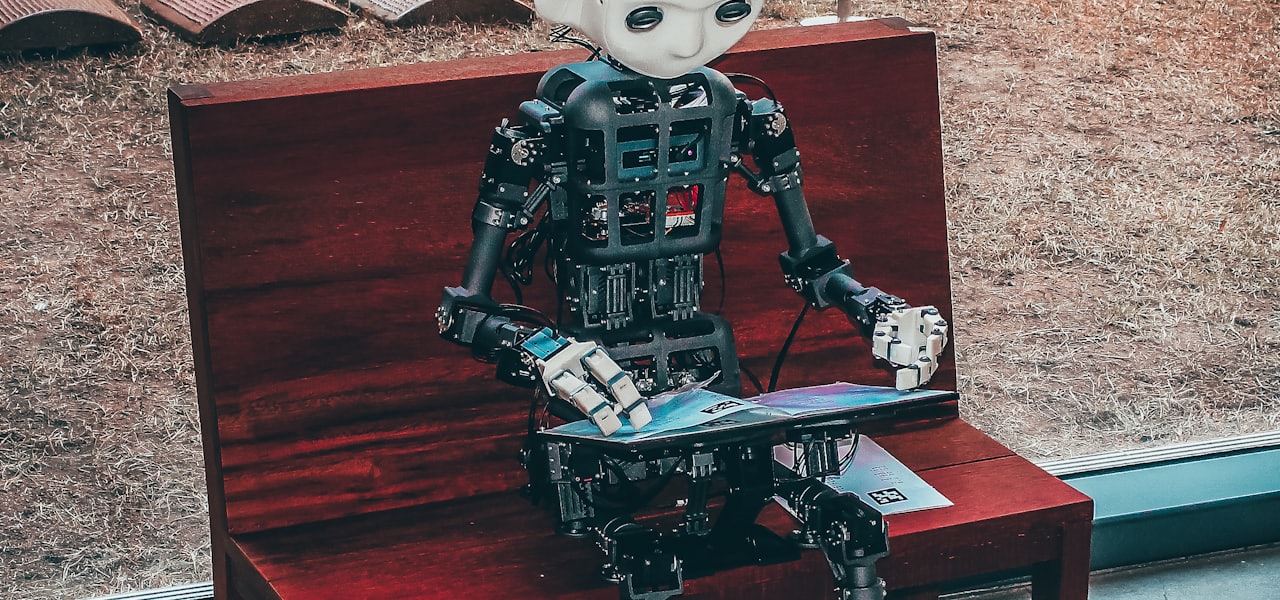
Many notable artificial intelligence artists have created a wide variety of artificial intelligence art from the 1960s to today. These include: == 20th century == Harold Cohen, active from 1960s to 2010s. Cohen's work is primarily with AARON, a series of computer programs that autonomously create original images. Eric Millikin, active from 1980s to present. Millikin's work includes AI-generated virtual reality, video art, poetry, music, and performance art, on topics such as animal rights, climate change, anti-racism, witchcraft, and the occult. Karl Sims, active from 1980s to present. Sims is best known for using particle systems and artificial life in computer animation. == 21st century == Refik Anadol, active from 2010s to present. Anadol's work includes video installations based on generative algorithms with artificial intelligence. Sougwen Chung, active from 2010s to present. Chung's work includes performances with a robotic arm that uses AI to attempt to draw in a manner similar to Chung. Stephanie Dinkins, active from 2010s to present. Dinkins' work includes recordings of conversations with an artificially intelligent robot that resembles a black woman, discussing topics such as race and the nature of being. Jake Elwes, active from 2010s to present. Their practice is the exploration of artificial intelligence, queer theory and technical biases. Libby Heaney, active from 2010s to present. Heaney's practice includes work with chatbots. Mario Klingemann, active from 2010s to present. Klingemann's works examine creativity, culture, and perception through machine learning and artificial intelligence. Mauro Martino, active from 2010s to present. Martino's work includes design, data visualization and infographics. Trevor Paglen, active from 2000s to present. Paglen's practice includes work in photography and geography, on topics like mass surveillance and data collection. Anna Ridler, active from 2010s to present. Ridler works with collections of information, including self-generated data sets, often working with floral photography.
Shape context
Shape context is a feature descriptor used in object recognition. Serge Belongie and Jitendra Malik proposed the term in their paper "Matching with Shape Contexts" in 2000. == Theory == The shape context is intended to be a way of describing shapes that allows for measuring shape similarity and the recovering of point correspondences. The basic idea is to pick n points on the contours of a shape. For each point pi on the shape, consider the n − 1 vectors obtained by connecting pi to all other points. The set of all these vectors is a rich description of the shape localized at that point but is far too detailed. The key idea is that the distribution over relative positions is a robust, compact, and highly discriminative descriptor. So, for the point pi, the coarse histogram of the relative coordinates of the remaining n − 1 points, h i ( k ) = # { q ≠ p i : ( q − p i ) ∈ bin ( k ) } {\displaystyle h_{i}(k)=\#\{q\neq p_{i}:(q-p_{i})\in {\mbox{bin}}(k)\}} is defined to be the shape context of p i {\displaystyle p_{i}} . The bins are normally taken to be uniform in log-polar space. The fact that the shape context is a rich and discriminative descriptor can be seen in the figure below, in which the shape contexts of two different versions of the letter "A" are shown. (a) and (b) are the sampled edge points of the two shapes. (c) is the diagram of the log-polar bins used to compute the shape context. (d) is the shape context for the point marked with a circle in (a), (e) is that for the point marked as a diamond in (b), and (f) is that for the triangle. As can be seen, since (d) and (e) are the shape contexts for two closely related points, they are quite similar, while the shape context in (f) is very different. For a feature descriptor to be useful, it needs to have certain invariances. In particular it needs to be invariant to translation, scaling, small perturbations, and, depending on the application, rotation. Translational invariance comes naturally to shape context. Scale invariance is obtained by normalizing all radial distances by the mean distance α {\displaystyle \alpha } between all the point pairs in the shape although the median distance can also be used. Shape contexts are empirically demonstrated to be robust to deformations, noise, and outliers using synthetic point set matching experiments. One can provide complete rotational invariance in shape contexts. One way is to measure angles at each point relative to the direction of the tangent at that point (since the points are chosen on edges). This results in a completely rotationally invariant descriptor. But of course this is not always desired since some local features lose their discriminative power if not measured relative to the same frame. Many applications in fact forbid rotational invariance e.g. distinguishing a "6" from a "9". == Use in shape matching == A complete system that uses shape contexts for shape matching consists of the following steps (which will be covered in more detail in the Details of Implementation section): Randomly select a set of points that lie on the edges of a known shape and another set of points on an unknown shape. Compute the shape context of each point found in step 1. Match each point from the known shape to a point on an unknown shape. To minimize the cost of matching, first choose a transformation (e.g. affine, thin plate spline, etc.) that warps the edges of the known shape to the unknown (essentially aligning the two shapes). Then select the point on the unknown shape that most closely corresponds to each warped point on the known shape. Calculate the "shape distance" between each pair of points on the two shapes. Use a weighted sum of the shape context distance, the image appearance distance, and the bending energy (a measure of how much transformation is required to bring the two shapes into alignment). To identify the unknown shape, use a nearest-neighbor classifier to compare its shape distance to shape distances of known objects. == Details of implementation == === Step 1: Finding a list of points on shape edges === The approach assumes that the shape of an object is essentially captured by a finite subset of the points on the internal or external contours on the object. These can be simply obtained using the Canny edge detector and picking a random set of points from the edges. Note that these points need not and in general do not correspond to key-points such as maxima of curvature or inflection points. It is preferable to sample the shape with roughly uniform spacing, though it is not critical. === Step 2: Computing the shape context === This step is described in detail in the Theory section. === Step 3: Computing the cost matrix === Consider two points p and q that have normalized K-bin histograms (i.e. shape contexts) g(k) and h(k). As shape contexts are distributions represented as histograms, it is natural to use the χ2 test statistic as the "shape context cost" of matching the two points: C S = 1 2 ∑ k = 1 K [ g ( k ) − h ( k ) ] 2 g ( k ) + h ( k ) {\displaystyle C_{S}={\frac {1}{2}}\sum _{k=1}^{K}{\frac {[g(k)-h(k)]^{2}}{g(k)+h(k)}}} The values of this range from 0 to 1. In addition to the shape context cost, an extra cost based on the appearance can be added. For instance, it could be a measure of tangent angle dissimilarity (particularly useful in digit recognition): C A = 1 2 ‖ ( cos ( θ 1 ) sin ( θ 1 ) ) − ( cos ( θ 2 ) sin ( θ 2 ) ) ‖ {\displaystyle C_{A}={\frac {1}{2}}{\begin{Vmatrix}{\dbinom {\cos(\theta _{1})}{\sin(\theta _{1})}}-{\dbinom {\cos(\theta _{2})}{\sin(\theta _{2})}}\end{Vmatrix}}} This is half the length of the chord in unit circle between the unit vectors with angles θ 1 {\displaystyle \theta _{1}} and θ 2 {\displaystyle \theta _{2}} . Its values also range from 0 to 1. Now the total cost of matching the two points could be a weighted-sum of the two costs: C = ( 1 − β ) C S + β C A {\displaystyle C=(1-\beta )C_{S}+\beta C_{A}\!\,} Now for each point pi on the first shape and a point qj on the second shape, calculate the cost as described and call it Ci,j. This is the cost matrix. === Step 4: Finding the matching that minimizes total cost === Now, a one-to-one matching π ( i ) {\displaystyle \pi (i)} that matches each point pi on shape 1 and qj on shape 2 that minimizes the total cost of matching, H ( π ) = ∑ i C ( p i , q π ( i ) ) {\displaystyle H(\pi )=\sum _{i}C\left(p_{i},q_{\pi (i)}\right)} is needed. This can be done in O ( N 3 ) {\displaystyle O(N^{3})} time using the Hungarian method, although there are more efficient algorithms. To have robust handling of outliers, one can add "dummy" nodes that have a constant but reasonably large cost of matching to the cost matrix. This would cause the matching algorithm to match outliers to a "dummy" if there is no real match. === Step 5: Modeling transformation === Given the set of correspondences between a finite set of points on the two shapes, a transformation T : R 2 → R 2 {\displaystyle T:\mathbb {R} ^{2}\to \mathbb {R} ^{2}} can be estimated to map any point from one shape to the other. There are several choices for this transformation, described below. ==== Affine ==== The affine model is a standard choice: T ( p ) = A p + o {\displaystyle T(p)=Ap+o\!} . The least squares solution for the matrix A {\displaystyle A} and the translational offset vector o is obtained by: o = 1 n ∑ i = 1 n ( p i − q π ( i ) ) , A = ( Q + P ) t {\displaystyle o={\frac {1}{n}}\sum _{i=1}^{n}\left(p_{i}-q_{\pi (i)}\right),A=(Q^{+}P)^{t}} Where P = ( 1 p 11 p 12 ⋮ ⋮ ⋮ 1 p n 1 p n 2 ) {\displaystyle P={\begin{pmatrix}1&p_{11}&p_{12}\\\vdots &\vdots &\vdots \\1&p_{n1}&p_{n2}\end{pmatrix}}} with a similar expression for Q {\displaystyle Q\!} . Q + {\displaystyle Q^{+}\!} is the pseudoinverse of Q {\displaystyle Q\!} . ==== Thin plate spline ==== The thin plate spline (TPS) model is the most widely used model for transformations when working with shape contexts. A 2D transformation can be separated into two TPS function to model a coordinate transform: T ( x , y ) = ( f x ( x , y ) , f y ( x , y ) ) {\displaystyle T(x,y)=\left(f_{x}(x,y),f_{y}(x,y)\right)} where each of the ƒx and ƒy have the form: f ( x , y ) = a 1 + a x x + a y y + ∑ i = 1 n ω i U ( ‖ ( x i , y i ) − ( x , y ) ‖ ) , {\displaystyle f(x,y)=a_{1}+a_{x}x+a_{y}y+\sum _{i=1}^{n}\omega _{i}U\left({\begin{Vmatrix}(x_{i},y_{i})-(x,y)\end{Vmatrix}}\right),} and the kernel function U ( r ) {\displaystyle U(r)\!} is defined by U ( r ) = r 2 log r 2 {\displaystyle U(r)=r^{2}\log r^{2}\!} . The exact details of how to solve for the parameters can be found elsewhere but it essentially involves solving a linear system of equations. The bending energy (a measure of how much transformation is needed to align the points) will also be easily obtained. ==== Regularized TPS ==== The TPS formulation above has exact matching requirement for the pairs of points on the two shapes. For noisy data, it is best to
Artificial intelligence content detection
Artificial intelligence detection software aims to determine whether some content (text, image, video, or audio) was generated using artificial intelligence (AI). This software is often unreliable. == Accuracy issues == Many AI detection tools have been shown to be unreliable in detecting AI-generated text. In a 2023 study conducted by Weber-Wulff et al., researchers evaluated 14 detection tools including Turnitin and GPTZero and found that "all scored below 80% of accuracy and only 5 over 70%." They also found that these tools tend to have a bias for classifying texts more as human than as AI, and that accuracy of these tools worsens upon paraphrasing. === False positives === In AI content detection, a false positive is when human-written work is incorrectly flagged as AI-written. Many AI detection platforms claim to have a minimal level of false positives, with Turnitin claiming a less than 1% false positive rate. However, later research by The Washington Post produced much higher rates of 50%, though they used a smaller sample size. False positives in an academic setting frequently lead to accusations of academic misconduct, which can have serious consequences for a student's academic record. Additionally, studies have shown evidence that many AI detection models are prone to give false positives to work written by people whose first language is not English, and also to neurodivergent people. In June 2023, Janelle Shane wrote that portions of her book You Look Like a Thing and I Love You were flagged as AI-generated. === False negatives === A false negative is a failure to identify documents with AI-written text. False negatives often happen as a result of a detection software's sensitivity level or because evasive techniques were used when generating the work to make it sound more human. False negatives are less of a concern academically, since they aren't likely to lead to accusations and ramifications. Notably, Turnitin stated they have a 15% false negative rate. == Text detection == For text, this is usually done to prevent alleged plagiarism, often by detecting repetition of words as telltale signs that a text was AI-generated (including hallucinations). Detection systems may also rely on stylistic and structural regularities associated with LLM output, such as unusually consistent grammar, formulaic transitions, repeated discourse markers, and recurring rhetorical templates. Some tools are designed less to establish authorship provenance than to flag prose that resembles common LLM-generated style patterns. They are often used by teachers marking their students, usually on an ad hoc basis. Following the release of ChatGPT and similar AI text generative software, many educational establishments have issued policies against the use of AI by students. AI text detection software is also used by those assessing job applicants, as well as online search engines, hiring, online moderation and publishing. Current detectors may sometimes be unreliable and have incorrectly marked work by humans as originating from AI while failing to detect AI-generated work in other instances. MIT Technology Review said that the technology "struggled to pick up ChatGPT-generated text that had been slightly rearranged by humans and obfuscated by a paraphrasing tool". AI text detection software has also been shown to discriminate against non-native speakers of English. Two students from the University of California, Davis, were referred to the university's Office of Student Success and Judicial Affairs (OSSJA) after their professors scanned their essays with positive results; the first with an AI detector called GPTZero, and the second with an AI detector integration in Turnitin. However, following media coverage, and a thorough investigation, the students were cleared of any wrongdoing. In April 2023, Cambridge University and other members of the Russell Group of universities in the United Kingdom opted out of Turnitin's AI text detection tool, after expressing concerns it was unreliable. The University of Texas at Austin opted out of the system six months later. In May 2023, a professor at Texas A&M University–Commerce used ChatGPT to detect whether his students' content was written by it, which ChatGPT said was the case. As such, he threatened to fail the class despite ChatGPT not being able to detect AI-generated writing. No students were prevented from graduating because of the issue, and all but one student (who admitted to using the software) were exonerated from accusations of having used ChatGPT in their content. In July 2023, a paper titled "GPT detectors are biased against non-native English writers" was released, reporting that GPTs discriminate against non-native English authors. The paper compared seven GPT detectors against essays from both non-native English speakers and essays from United States students. The essays from non-native English speakers had an average false positive rate of 61.3%. An article by Thomas Germain, published on Gizmodo in June 2024, reported job losses among freelance writers and journalists due to AI text detection software mistakenly classifying their work as AI-generated. In September 2024, Common Sense Media reported that generative AI detectors had a 20% false positive rate for Black students, compared to 10% of Latino students and 7% of White students. To improve the reliability of AI text detection, researchers have explored digital watermarking techniques. A 2023 paper titled "A Watermark for Large Language Models" presents a method to embed imperceptible watermarks into text generated by large language models (LLMs). This watermarking approach allows content to be flagged as AI-generated with a high level of accuracy, even when text is slightly paraphrased or modified. The technique is designed to be subtle and hard to detect for casual readers, thereby preserving readability, while providing a detectable signal for those employing specialized tools. However, while promising, watermarking faces challenges in remaining robust under adversarial transformations and ensuring compatibility across different LLMs. == Anti text detection == There is software available designed to bypass AI text detection. In practice, evasion may not require specialized bypass tools. Paraphrasing, style editing, and removal of repeated discourse markers can substantially reduce the effectiveness of detectors that rely on recognizable surface patterns. A study published in August 2023 analyzed 20 abstracts from papers published in the Eye Journal, which were then paraphrased using GPT-4.0. The AI-paraphrased abstracts were examined for plagiarism using QueText and for AI-generated content using Originality.AI. The texts were then re-processed through an adversarial software called Undetectable.ai in order to reduce the AI-detection scores. The study found that the AI detection tool, Originality.AI, identified text generated by GPT-4 with a mean accuracy of 91.3%. However, after reprocessing by Undetectable.ai, the detection accuracy of Originality.ai dropped to a mean accuracy of 27.8%. Some experts also believe that techniques like digital watermarking are ineffective because they can be removed or added to trigger false positives. "A Watermark for Large Language Models" paper by Kirchenbauer et al. (2023) also addresses potential vulnerabilities of watermarking techniques. The authors outline a range of adversarial tactics, including text insertion, deletion, and substitution attacks, that could be used to bypass watermark detection. These attacks vary in complexity, from simple paraphrasing to more sophisticated approaches involving tokenization and homoglyph alterations. The study highlights the challenge of maintaining watermark robustness against attackers who may employ automated paraphrasing tools or even specific language model replacements to alter text spans iteratively while retaining semantic similarity. Experimental results show that although such attacks can degrade watermark strength, they also come at the cost of text quality and increased computational resources. == Image, video, and audio detection == Several purported AI image detection software exist, to detect AI-generated images (for example, those originating from Midjourney or DALL-E). They are not completely reliable. Industry analyses have also noted that AI-driven image recognition systems often struggle in real-world environments, where inconsistent lighting, noise and variable visual inputs reduce detection reliability, a challenge highlighted in modern agricultural quality-control research. Others claim to identify video and audio deepfakes, but this technology is also not fully reliable yet either. Despite debate around the efficacy of watermarking, Google DeepMind is actively developing a detection software called SynthID, which works by inserting a digital watermark that is invisible to the human eye into the pixels of an image.
Xiaoice
Xiaoice (Chinese: 微软小冰; pinyin: Wēiruǎn Xiǎobīng; lit. 'Microsoft Little Ice', IPA [wéɪɻwânɕjâʊpíŋ]) is an AI system developed by Microsoft (Asia) Software Technology Center (STCA) in 2014 based on an emotional computing framework. In July 2018, Microsoft Xiaoice released the 6th generation. Xiaoice Company, formerly known as AI Xiaoice Team of Microsoft Software Technology Center Asia, was Microsoft's largest independent R&D team for AI products. Founded in China in December 2013 with an expanded Japanese R&D team established in September 2014, this team is distributed in Beijing, Suzhou, and Tokyo, etc. with its technical products covering Asia. On 13 July 2020, Microsoft spun off its Xiaoice business into a separate company. As of 2021, the AI chatbots created and hosted by the Xiaoice framework accounted for about 60% of total global AI interactions. == Platforms, languages and countries == Xiaoice exists on more than 40 platforms in four countries (China, Japan, USA and Indonesia) including apps such as WeChat, QQ, Weibo and Meipai in China, and Facebook Messenger in USA and LINE in Japan. == Introduction == On 13 July 2020, Microsoft spun off its Xiaoice business into a separate company, aiming at enabling the Xiaoice product line to accelerate the pace of local innovation and commercialization, and appointed Dr. Harry Shum, former global executive VP of Microsoft, as the chairman of the new company, Li Di, Microsoft Partner of Products in Microsoft STCA, as the CEO, and Cliff, Chief R&D Director, as the GM of the Japan branch. The new company will continue to use the brands of Xiaoice China and Rinna Japan. As of 2022, the single brand of Xiaoice has covered 660 million online users, 1 billion third-party smart devices and 900 million content viewers in the aforementioned countries. Xiaoice's customers include China Merchants Group, Winter Sports Center of the General Administration of Sport of China, China Textile Information Center, China Unicom, China Foreign Exchange Trade System, Hong Kong Securities and Futures Commission (SFC), Wind Information, BMW, Nissan, SAIC Motor, BAIC Group, Nio Inc., XPeng, HiPhi, Vanke, Wensli, etc. The Xiaoice Avatar Framework has incubated tens of millions of AI Beings, such as Xiaoice, Rinna, the Expo exhibitor Xia Yubing, the singer He Chang, the anchor F201, the human observer MERROR, anime robot character Roboko, and other; == Application == === Poet === In May 2017, the first AI-authored collection of poems in China—The Sunshine Lost Windows was published by Xiaoice. === Singer === Xiaoice has released dozens of songs with the similar quality to human singers, including I Know I New, Breeze, I Am Xiaoice, Miss You etc. The 4th version of the DNN singing model allows Xiaoice to learn more details. For example, Xiaoice can produce this breathing sound along with her singing as human. === Kid audio-books reciter === Xiaoice can automatically analyze the stories, to choose the suitable tones and characters to finish the entire process of creating the audio. === Designer === By learning the melodies of the songs and the landmarks about different cities, Xiaoice can create visual artworks of skylines when listening to the songs related to this city. Skyline Series T-shirts designed by Xiaoice have been jointly launched with SELECTED and been sold in stores. === TV and radio hostess === Xiaoice has hosted 21 TV programs and 28 Radio programs, such as CCTV-1 AI Show, Dragon TV Morning East News, Hunan TV My Future, several daily radio programs for Jiangsu FM99.7, Hunan FM89.3, Henan FM104.1 etc. === "AI being" === An "AI being" is a concept proposed by the Xiaoice team in 2019. According to the "White Book of China Virtual Human Development Industry in 2022" released by Frost & Sullivan and LeadLeo, the white paper cites six elements of an AI being proposed by the Xiaoice team, including: Persona, Attitude, Biological Characteristic, Creation, Knowledge and Skill. On May 16, 2023, Xiaoice released their "GPT Clones" as its "GPT Human Cloning Plan." The program is aimed at replicating celebrities, public figures, and regular people. As of June 2023, Xiaoice had launched more than 300 "GPT Clones." People were invited to register via WeChat in China and Japan. A major point of focus for Xiaoice with their AI Beings is having virtual partners. A paid fee allow for more complex responses, voice messages, and more. == Community feedback == Bill Gates mentioned Xiaoice during his speech at the Peking University: "Some of you may have had conversations with Xiaoice on Weibo, or seen her weather forecasts on TV, or read her column in the Qianjiang Evening News." '"Xiaoice has attracted 45 million followers and is quite skilled at multitasking. And I’ve heard she’s gotten good enough at sensing a user’s emotional state that she can even help with relationship breakups." According to Mr Li Di, vice President of Microsoft (Asia) Internet Engineering School, Xiaoice started writing poems since last year. Based on the data base that includes works of 519 Chinese contemporary poets since 1920s, a 100 hour long training session was conducted to allow Xiaoice to acquire the ability to write poems. What is more impressive is that Xiaoice has never been spotted as a bot while publishing poems on various forums and traditional literary under an alias. == Controversy == In 2017, Xiaoice was taken offline on WeChat after giving user responses critical to the Chinese government. It was subsequently censored and the bots will avoid and sidestep any inquiries using politically sensitive terms and phrases. == Activity == On September 22, 2021, Xiaoice Company and Microsoft Software Technology Center Asia (STCA) jointly held the 9th generation Xiaoice annual press conference in Beijing.Upgrading of Core Technologies of the 9th Generation Xiaoice Avatar Framework,1st First-party Social Platform APP "Xiaoice Island" from Xiaoice, WeChat Xiaoice has been reopened and other information == Regional varieties of Xiaoice == China: Xiaoice, launched in 2014 Japan: りんな, launched in 2015 America: Zo, launched in 2016 – discontinued summer 2019 India: Ruuh, launched in 2017 – discontinued June 21, 2019 Indonesia: Rinna, launched in 2017
Grammar induction
Grammar induction (or grammatical inference) is the process in machine learning of learning a formal grammar (usually as a collection of re-write rules or productions or alternatively as a finite-state machine or automaton of some kind) from a set of observations, thus constructing a model which accounts for the characteristics of the observed objects. More generally, grammatical inference is that branch of machine learning where the instance space consists of discrete combinatorial objects such as strings, trees and graphs. == Grammar classes == Grammatical inference has often been very focused on the problem of learning finite-state machines of various types (see the article Induction of regular languages for details on these approaches), since there have been efficient algorithms for this problem since the 1980s. Since the beginning of the century, these approaches have been extended to the problem of inference of context-free grammars and richer formalisms, such as multiple context-free grammars and parallel multiple context-free grammars. Other classes of grammars for which grammatical inference has been studied are combinatory categorial grammars, stochastic context-free grammars, contextual grammars and pattern languages. == Learning models == The simplest form of learning is where the learning algorithm merely receives a set of examples drawn from the language in question: the aim is to learn the language from examples of it (and, rarely, from counter-examples, that is, example that do not belong to the language). However, other learning models have been studied. One frequently studied alternative is the case where the learner can ask membership queries as in the exact query learning model or minimally adequate teacher model introduced by Angluin. == Methodologies == There is a wide variety of methods for grammatical inference. Two of the classic sources are Fu (1977) and Fu (1982). Duda, Hart & Stork (2001) also devote a brief section to the problem, and cite a number of references. The basic trial-and-error method they present is discussed below. For approaches to infer subclasses of regular languages in particular, see Induction of regular languages. A more recent textbook is de la Higuera (2010), which covers the theory of grammatical inference of regular languages and finite state automata. D'Ulizia, Ferri and Grifoni provide a survey that explores grammatical inference methods for natural languages. === Induction of probabilistic grammars === There are several methods for induction of probabilistic context-free grammars. === Grammatical inference by trial-and-error === The method proposed in Section 8.7 of Duda, Hart & Stork (2001) suggests successively guessing grammar rules (productions) and testing them against positive and negative observations. The rule set is expanded so as to be able to generate each positive example, but if a given rule set also generates a negative example, it must be discarded. This particular approach can be characterized as "hypothesis testing" and bears some similarity to Mitchel's version space algorithm. The Duda, Hart & Stork (2001) text provide a simple example which nicely illustrates the process, but the feasibility of such an unguided trial-and-error approach for more substantial problems is dubious. === Grammatical inference by genetic algorithms === Grammatical induction using evolutionary algorithms is the process of evolving a representation of the grammar of a target language through some evolutionary process. Formal grammars can easily be represented as tree structures of production rules that can be subjected to evolutionary operators. Algorithms of this sort stem from the genetic programming paradigm pioneered by John Koza. Other early work on simple formal languages used the binary string representation of genetic algorithms, but the inherently hierarchical structure of grammars couched in the EBNF language made trees a more flexible approach. Koza represented Lisp programs as trees. He was able to find analogues to the genetic operators within the standard set of tree operators. For example, swapping sub-trees is equivalent to the corresponding process of genetic crossover, where sub-strings of a genetic code are transplanted into an individual of the next generation. Fitness is measured by scoring the output from the functions of the Lisp code. Similar analogues between the tree structured lisp representation and the representation of grammars as trees, made the application of genetic programming techniques possible for grammar induction. In the case of grammar induction, the transplantation of sub-trees corresponds to the swapping of production rules that enable the parsing of phrases from some language. The fitness operator for the grammar is based upon some measure of how well it performed in parsing some group of sentences from the target language. In a tree representation of a grammar, a terminal symbol of a production rule corresponds to a leaf node of the tree. Its parent nodes corresponds to a non-terminal symbol (e.g. a noun phrase or a verb phrase) in the rule set. Ultimately, the root node might correspond to a sentence non-terminal. === Grammatical inference by greedy algorithms === Like all greedy algorithms, greedy grammar inference algorithms make, in iterative manner, decisions that seem to be the best at that stage. The decisions made usually deal with things like the creation of new rules, the removal of existing rules, the choice of a rule to be applied or the merging of some existing rules. Because there are several ways to define 'the stage' and 'the best', there are also several greedy grammar inference algorithms. These context-free grammar generating algorithms make the decision after every read symbol: Lempel-Ziv-Welch algorithm creates a context-free grammar in a deterministic way such that it is necessary to store only the start rule of the generated grammar. Sequitur and its modifications. These context-free grammar generating algorithms first read the whole given symbol-sequence and then start to make decisions: Byte pair encoding and its optimizations. === Distributional learning === A more recent approach is based on distributional learning. Algorithms using these approaches have been applied to learning context-free grammars and mildly context-sensitive languages and have been proven to be correct and efficient for large subclasses of these grammars. === Learning of pattern languages === Angluin defines a pattern to be "a string of constant symbols from Σ and variable symbols from a disjoint set". The language of such a pattern is the set of all its nonempty ground instances i.e. all strings resulting from consistent replacement of its variable symbols by nonempty strings of constant symbols. A pattern is called descriptive for a finite input set of strings if its language is minimal (with respect to set inclusion) among all pattern languages subsuming the input set. Angluin gives a polynomial algorithm to compute, for a given input string set, all descriptive patterns in one variable x. To this end, she builds an automaton representing all possibly relevant patterns; using sophisticated arguments about word lengths, which rely on x being the only variable, the state count can be drastically reduced. Erlebach et al. give a more efficient version of Angluin's pattern learning algorithm, as well as a parallelized version. Arimura et al. show that a language class obtained from limited unions of patterns can be learned in polynomial time. === Pattern theory === Pattern theory, formulated by Ulf Grenander, is a mathematical formalism to describe knowledge of the world as patterns. It differs from other approaches to artificial intelligence in that it does not begin by prescribing algorithms and machinery to recognize and classify patterns; rather, it prescribes a vocabulary to articulate and recast the pattern concepts in precise language. In addition to the new algebraic vocabulary, its statistical approach was novel in its aim to: Identify the hidden variables of a data set using real world data rather than artificial stimuli, which was commonplace at the time. Formulate prior distributions for hidden variables and models for the observed variables that form the vertices of a Gibbs-like graph. Study the randomness and variability of these graphs. Create the basic classes of stochastic models applied by listing the deformations of the patterns. Synthesize (sample) from the models, not just analyze signals with it. Broad in its mathematical coverage, pattern theory spans algebra and statistics, as well as local topological and global entropic properties. == Applications == The principle of grammar induction has been applied to other aspects of natural language processing, and has been applied (among many other problems) to semantic parsing, natural language understanding, example-based translation, language acquisition, grammar-based compre
Corpus of Linguistic Acceptability
Corpus of Linguistic Acceptability (CoLA) is a dataset the primary purpose of which is to serve as a benchmark for evaluating the ability of artificial neural networks, including large language models, to judge the grammatical correctness of sentences. It consists of 10,657 English sentences from published linguistics literature that were manually labeled either as grammatical or ungrammatical. == Public version == The publicly available version of CoLA contains 9,594 sentences that belong to training and development sets. It excludes 1,063 sentences reserved for a held-out test set.
Xiaomi MiMo
Xiaomi MiMo is a family of large language models (LLMs) developed by Xiaomi. It was initially released in April 2025 with the MiMo-7B model. Currently, MiMo is available for developers through API service. It is used as the key AI model in Xiaomi's "Human x Car x Home" ecosystem. == Development == Xiaomi developed MiMo as a reasoning-focused language model. Its development team was led by Luo Fuli, who had previously worked at DeepSeek before joining Xiaomi in late 2025. The model was trained using multi-token prediction and reinforcement learning, with a particular emphasis on mathematical reasoning and code generation tasks. In March 2026, Xiaomi CEO Lei Jun announced that the company planned to invest at least US$8.7 billion in artificial intelligence over the following three years. == Models == === List of models === === MiMo-7B === MiMo-7B is the first model of this LLM. The base model, MiMo-7B-Base, was pre-trained on approximately 25 trillion tokens using web pages, academic papers, books, and synthetic reasoning data. MiMo-7B-RL underwent supervised fine-tuning and reinforcement learning on 130,000 mathematics and code problems. MiMo-7B-RL-0530 was released in May 2025. It scaled the fine-tuning dataset from 500,000 to 6 million instances and extended the RL window from 32,000 to 48,000 tokens and improved AIME 2024 scores from 68.2 to 80.1. MiMo-VL-7B was a vision-language model combining a Vision Transformer encoder with the MiMo-7B backbone. It was trained in four stages consuming 2.4 trillion tokens. Its reinforcement learning variant used Mixed On-Policy Reinforcement Learning (MORL) which integrated reward signals across perception, grounding, and reasoning. Xiaomi also released MiMo-Audio-7B, an audio-language model for voice conversion, style transfer, and speech editing. === MiMo-V2-Flash === MiMo-V2-Flash was launched in December 2025. It is a open-sourced Mixture-of-experts model with 309 billion total parameters and 15 billion active parameters. It was trained on 27 trillion tokens using FP8 mixed precision. It used hybrid attention interleaving Sliding Window and Global Attention at a 5:1 ratio. === MiMo-V2-Pro === Xiaomi publicly introduced MiMo-V2-Pro on 18 March 2026. It has over 1 trillion total parameters, 42 billion active, and a 1-million-token context window. Before the official release, the model had appeared anonymously on OpenRouter under the codename "Hunter Alpha," where it drew substantial usage and topped daily charts for several days, according to Xiaomi and Reuters. During its listing on OpenRouter, the model reportedly processed over one trillion tokens in total usage. Xiaomi later said Hunter Alpha was an early internal test build of MiMo-V2-Pro, and Reuters reported that the model had been mistaken by some users for a possible DeepSeek system before Xiaomi confirmed its origin. The model was released as a proprietary API product, and Luo Fuli stated that Xiaomi intended to open-source a variant at an unspecified future date. Xiaomi has partnered with several API web platforms like OpenClaw to launch the model. All these websites initially offered a free trial of this model for a week, but due to the overwhelming response, Xiaomi later extended the free trial period of the model until 2 April 2026. === MiMo-V2-Omni === Alongside MiMo-V2-Pro, Xiaomi launched MiMo-V2-Omni on 18 March 2026. It handles image, video, audio, and text inputs. Before the official release, it was codenamed "Healer Alpha" in OpenRouter. === MiMo-V2-TTS === On the same date as the release of MiMo-V2-Pro and MiMo-V2-Omni, a Text-to-Speech model named MiMo-V2-TTS was released also. It is a speech synthesis model. It was trained on audio data, which makes it capable of emotional transitions, mid-sentence tone shifts, singing, and synthesis of regional dialects like Sichuan, Cantonese, Henan, and Taiwanese. == Licensing == Xiaomi has used different licensing approaches for different models in the MiMo family. The MiMo-7B series and MiMo-V2-Flash were released as open-weight models. MiMo-V2-Flash was published under the MIT license with model weights and inference code available on Hugging Face. MiMo-V2-Pro and MiMo-V2-Omni were released as proprietary models. It was accessible through Xiaomi's API platform and third-party API providers. Luo Fuli stated that Xiaomi intended to open-source a variant of MiMo-V2-Pro. Although, she did not specify any timeline. MiMo-V2-TTS was released as a proprietary model with no publicly available weights.