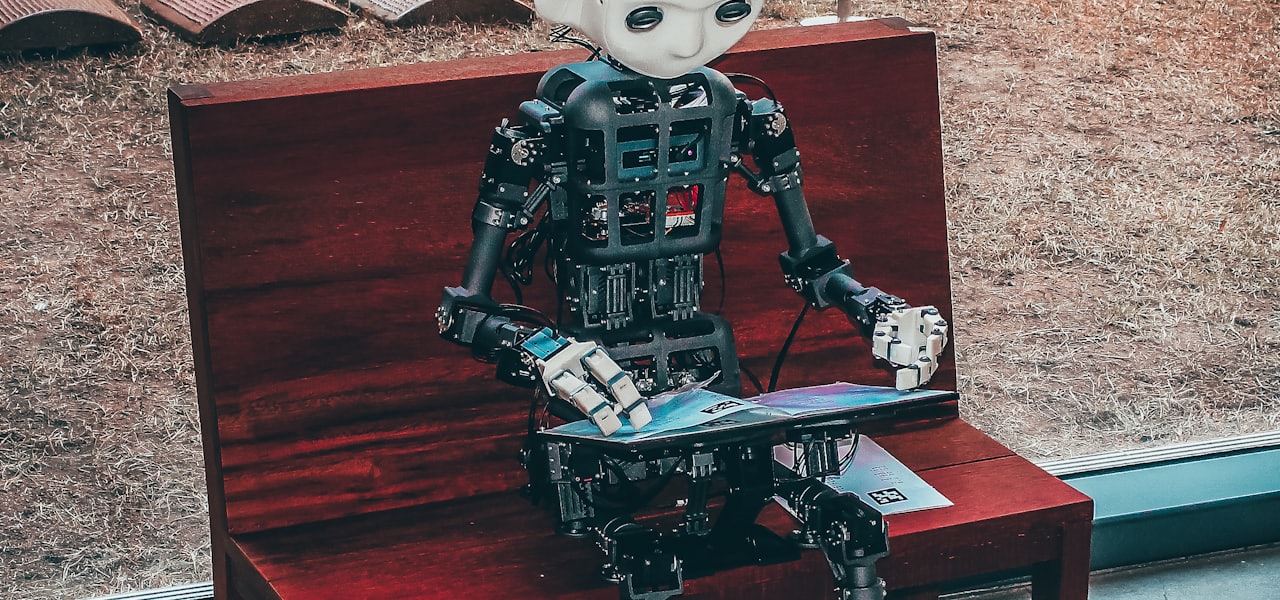
Distributed Artificial Intelligence (DAI) (also called Decentralized Artificial Intelligence) is a melding of artificial intelligence with distributed computing. From artificial intelligence comes the theory and technology for constructing or analyzing an intelligent system. But where artificial intelligence uses psychology as a source of ideas, inspiration, and metaphor, DAI uses sociology, economics, and management science for inspiration. Where the focus of artificial intelligence is on the individual, the focus of DAI is on the group. Distributed computing provides the computational substrate on which this group focus can occur. Using techniques from artificial intelligence, communication theory, control theory, and interaction theory, it produces a cooperative solution to problems by a decentralized group of computational entities (agents). DAI is closely related to and a predecessor of the field of multi-agent systems. They are distinguished generally by multi-agent systems being open, where the entities might arise from different interests and have individual goals, and distributed artificial-intelligence systems, where the entities have common goals. There are numerous applications and tools. == Definition == Distributed Artificial Intelligence (DAI) is an approach to solving complex learning, planning, and decision-making problems. It is embarrassingly parallel, thus able to exploit large scale computation and spatial distribution of computing resources. These properties allow it to solve problems that require the processing of very large data sets. DAI systems consist of autonomous learning processing nodes (agents), that are distributed, often at a very large scale. DAI nodes can act independently, and partial solutions are integrated by communication between nodes, often asynchronously. By virtue of their scale, DAI systems are robust and elastic, and by necessity, loosely coupled. Furthermore, DAI systems are built to be adaptive to changes in the problem definition or underlying data sets due to the scale and difficulty in redeployment. DAI systems do not require all the relevant data to be aggregated in a single location, in contrast to monolithic or centralized Artificial Intelligence systems, which have tightly coupled and geographically close processing nodes. Therefore, DAI systems often operate on sub-samples or hashed impressions of very large datasets. In addition, the source dataset may change or be updated during the course of the execution of a DAI system. == Development == In 1975 distributed artificial intelligence emerged as a subfield of artificial intelligence that dealt with interactions of intelligent agents. As a scientific discipline, it progressed through a series of workshops in the USA (International Workshop on Distributed Artificial Intelligence, held in 13 editions from 1978 - 1994), Europe (Workshop on Modelling Autonomous Agents in a Multi-Agent World https://link.springer.com/conference/maamaw), and Asia (Multi-Agent and Cooperative Computation Workshop (MACC) https://sites.google.com/view/sig-macc/macc-workshop?authuser=0). Distributed artificial intelligence systems were conceived as a group of intelligent entities, called agents, that interacted by cooperation, by coexistence, or by competition. DAI is categorized into multi-agent systems and distributed problem solving. In multi-agent systems the main focus is how agents coordinate their knowledge and activities. For distributed problem solving the major focus is how the problem is decomposed and the solutions are synthesized. == Goals == The objectives of Distributed Artificial Intelligence are to solve the reasoning, planning, learning and perception problems of artificial intelligence, especially if they require large data, by distributing the problem to autonomous processing nodes (agents). To reach the objective, DAI requires: A distributed system with robust and elastic computation on unreliable and failing resources that are loosely coupled Coordination of the actions and communication of the nodes Subsamples of large data sets and online machine learning There are many reasons for wanting to distribute intelligence or cope with multi-agent systems. Mainstream problems in DAI research include the following: Parallel problem solving: mainly deals with how classic artificial intelligence concepts can be modified, so that multiprocessor systems and clusters of computers can be used to speed up calculation. Distributed problem solving (DPS): the concept of agent, autonomous entities that can communicate with each other, was developed to serve as an abstraction for developing DPS systems. See below for further details. Multi-Agent Based Simulation (MABS): a branch of DAI that builds the foundation for simulations that need to analyze not only phenomena at macro level but also at micro level, as it is in many social simulation scenarios. == Approaches == Two types of DAI has emerged: In Multi-agent systems agents coordinate their knowledge and activities and reason about the processes of coordination. Agents are physical or virtual entities that can act, perceive their environment, and communicate with other agents. An agent is autonomous and has skills to achieve goals. The agents change the state of their environment by their actions. There are a number of different coordination techniques. In distributed problem solving the work is divided among nodes and the knowledge is shared. The main concerns are task decomposition and synthesis of the knowledge and solutions. DAI can apply a bottom-up approach to AI, similar to the subsumption architecture as well as the traditional top-down approach of AI. In addition, DAI can also be a vehicle for emergence. === Challenges === The challenges in Distributed AI are: How to carry out communication and interaction of agents and which communication language or protocols should be used. How to ensure the coherency of agents. How to synthesise the results among 'intelligent agents' group by formulation, description, decomposition and allocation. == Applications and tools == Areas where DAI have been applied are: Electronic commerce, e.g. for trading strategies the DAI system learns financial trading rules from subsamples of very large samples of financial data Networks, e.g. in telecommunications the DAI system controls the cooperative resources in a WLAN network Routing, e.g. model vehicle flow in transport networks Scheduling, e.g. flow shop scheduling where the resource management entity ensures local optimization and cooperation for global and local consistency Search engines, e.g. in LLM federated search like Ithy where document retrieval and analysis are distributed to DAI agents before aggregation Multi-Agent systems, e.g. artificial life, the study of simulated life Electric power systems, e.g. Condition Monitoring Multi-Agent System (COMMAS) applied to transformer condition monitoring, and IntelliTEAM II Automatic Restoration System DAI integration in tools has included: ECStar is a distributed rule-based learning system. == Agents == === Systems: Agents and multi-agents === Notion of Agents: Agents can be described as distinct entities with standard boundaries and interfaces designed for problem solving. Notion of Multi-Agents: Multi-Agent system is defined as a network of agents which are loosely coupled working as a single entity like society for problem solving that an individual agent cannot solve. === Software agents === The key concept used in DPS and MABS is the abstraction called software agents. An agent is a virtual (or physical) autonomous entity that has an understanding of its environment and acts upon it. An agent is usually able to communicate with other agents in the same system to achieve a common goal, that one agent alone could not achieve. This communication system uses an agent communication language. A first classification that is useful is to divide agents into: reactive agent – A reactive agent is not much more than an automaton that receives input, processes it and produces an output. deliberative agent – A deliberative agent in contrast should have an internal view of its environment and is able to follow its own plans. hybrid agent – A hybrid agent is a mixture of reactive and deliberative, that follows its own plans, but also sometimes directly reacts to external events without deliberation. Well-recognized agent architectures that describe how an agent is internally structured are: ASMO (emergence of distributed modules) BDI (Believe Desire Intention, a general architecture that describes how plans are made) InterRAP (A three-layer architecture, with a reactive, a deliberative and a social layer) PECS (Physics, Emotion, Cognition, Social, describes how those four parts influences the agents behavior). Soar (a rule-based approach)
Automated parking system
An automated (car) parking system (APS) is a mechanical system designed to minimize the area and/or volume required for parking cars. Like a multi-story parking garage, an APS provides parking for cars on multiple levels stacked vertically to maximize the number of parking spaces while minimizing land usage. The APS, however, utilizes a mechanical system to transport cars to and from parking spaces (rather than the driver) in order to eliminate much of the space wasted in a multi-story parking garage. While a multi-story parking garage is similar to multiple parking lots stacked vertically, an APS is more similar to an automated storage and retrieval system for cars. Parking systems are generally powered by electric motors or hydraulic pumps that move vehicles into a storage position.The paternoster (shown animated at the right) is an example of one of the earliest and most common types of APS. APS are also generically known by a variety of other names, including:automated parking facility (APF), automated vehicle storage and retrieval system (AVSRS), car parking system, mechanical parking, and robotic parking garage. == History == The concept for the automated parking system was and is driven by two factors: a need for parking spaces and a scarcity of available land. The earliest use of an APS was in Paris, France in 1905 at the Garage Rue de Ponthieu. The APS consisted of a groundbreaking multi-story concrete structure with an internal car elevator to transport cars to upper levels where attendants parked the cars. In the 1920s, a Ferris wheel-like APS (for cars rather than people) called a paternoster system became popular as it could park eight cars in the ground space normally used for parking two cars. Mechanically simple with a small footprint, the paternoster was easy to use in many places, including inside buildings. At the same time, Kent Automatic Garages was installing APS with capacities exceeding 1,000 cars. The “ferris-wheel,” or paternoster system — was created by the Westinghouse Corporation in 1923 and subsequently built in 1932 on Chicago's Monroe Street. The Nash Motor Company created the first glass-enclosed version of this system for the Chicago Century of Progress Exhibition in 1933 The first driverless parking garage opened in 1951 in Washington, D.C., but was replaced with office space due to increasing land values. APS saw a spurt of interest in the U.S. in the late 1940s and 1950s with the Bowser, Pigeon Hole and Roto Park systems. In 1957, 74 Bowser, Pigeon Hole systems were installed, and some of these systems remain in operation. However, interest in APS in the U.S. waned due to frequent mechanical problems and long waiting times for patrons to retrieve their cars. In the United Kingdom, the Auto Stacker opened in 1961 in Woolwich, south east London, but proved equally difficult to operate. Interest in APS in the U.S. was renewed in the 1990s, and there were 25 major current and planned APS projects (representing nearly 6,000 parking spaces) in 2012. The first American robotic parking garage opened in 2002 in Hoboken, New Jersey. While interest in the APS in the U.S. languished until the 1990s, Europe, Asia and Central America had been installing more technically advanced APS since the 1970s. In the early 1990s, nearly 40,000 parking spaces were being built annually using the paternoster APS in Japan. In 2012, there are an estimated 1.6 million APS parking spaces in Japan. The ever-increasing scarcity of available urban land (urbanization) and increase of the number of cars in use (motorization) have combined with sustainability and other quality-of-life issues to renew interest in APS as alternatives to multi-storey car parks, on-street parking, and parking lots. == Largest systems == The largest Automated Parking Facility in the world is in Al Jahra, Kuwait, and provides 2,314 parking spaces. The world's fastest Automated Parking System is in Wolfsburg, Germany, with a retrieval time of 1 minute and 44 seconds. The largest APS in Europe is at Dokk1 in Aarhus, Denmark, and provides 1,000 parking spaces via 20 car lifts. == Space saving == All APS take advantage of a common concept to decrease the area of parking spaces - removing the driver and passengers from the car before it is parked. With either fully automated or semi-automated APS, the car is driven up to an entry point to the APS and the driver and passengers exit the car. The car is then moved automatically or semi-automatically (with some attendant action required) to its parking space. The space-saving provided by the APS, compared to the multi-story parking garage, is derived primarily from a significant reduction in space not directly related to the parking of the car: Parking space width and depth (and distances between parking spaces) are dramatically reduced since no allowance need be made for driving the car into the parking space or for the opening of car doors (for drivers and passengers) No driving lanes or ramps are needed to drive the car to/from the entrance/exit to a parking space Ceiling height is minimized since there is no pedestrian traffic (drivers and passengers) in the parking area, and No walkways, stairways or elevators are needed to accommodate pedestrians in the parking area. With the elimination of ramps, driving lanes, pedestrians and the reduction in ceiling heights, the APS requires substantially less structural material than the multi-story parking garage. Many APS utilize a steel framework (some use thin concrete slabs) rather than the monolithic concrete design of the multi-story parking garage. These factors contribute to an overall volume reduction and further space savings for the APS. == Other considerations == In addition to the space saving, many APS designs provide a number of secondary benefits: The parked cars and their contents are more secure since there is no public access to parked cars Minor parking lot damage such as scrapes and dents are eliminated Drivers and passengers are safer not having to walk through parking lots or garages Driving around in search of a parking space is eliminated, thereby reducing engine emissions and wasted time Only minimal ventilation and lighting systems are needed Handicap access is improved The volume and visual impact of the parking structure is minimized Shorter construction time === Problems === There have been a number of problems with robotic parking systems, particularly in the United States. The systems work well in balanced throughput situations like shopping malls and train stations, but they are unsuited to high peak volume applications like rush hour usage or stadiums and they suffer from technical problems. Further, parkers not familiar with the system may cause problems, for example by failing to push the button to alert a fully automated system to the presence of a car to be parked. In London around 40 vehicles were trapped for two years in CBRE's system. == Fully automated vs semi-automated == Fully automated parking systems operate much like robotic valet parking. The driver drives the car into an APS entry (transfer) area. The driver and all passengers exit the car. The driver uses an automated terminal nearby for payment and receipt of a ticket. When driver and passengers have left the entry area, the mechanical system lifts the car and transports it to a pre-determined parking space in the system. More sophisticated fully automated APS will obtain the dimensions of cars on entry in order to place them in the smallest available parking space. The driver retrieves a car by inserting a ticket or code into an automated terminal. The APS lifts the car from its parking space and delivers it to an exit area. Most often, the retrieved car has been oriented to eliminate the need for the driver to back out. Fully automated APS theoretically eliminate the need for parking attendants. Semi-automated APS also use a mechanical system of some type to move a car to its parking space, however putting the car into and/or the operation of the system requires some action by an attendant or the driver. The choice between fully and semi-automated APS is often a matter of space and cost, however large capacity (> 100 cars) tend to be fully automated. == Applications == By virtue of their relatively smaller volume and mechanized parking systems, APS are often used in locations where a multi-story parking garage would be too large, too costly or impractical. Examples of such applications include, under or inside existing or new structures, between existing structures and in irregularly shaped areas. APS can also be applied in situations similar to multi-storey parking garages such as freestanding above ground, under buildings above grade and under buildings below grade. == Costs == The direct comparison of costs between an APS and a multi-story parking garage can be complicated by many variables such as capacity, land costs, area shape, number and location of entranc
Weak supervision
Weak supervision (also known as semi-supervised learning) is a paradigm in machine learning, the relevance and notability of which increased with the advent of large language models due to the large amount of data required to train them. It is characterized by using a combination of a small amount of human-labeled data (exclusively used in more expensive and time-consuming supervised learning paradigm), followed by a large amount of unlabeled data (used exclusively in unsupervised learning paradigm). In other words, the desired output values are provided only for a subset of the training data. The remaining data is unlabeled or imprecisely labeled. Intuitively, it can be seen as an exam and labeled data as sample problems that the teacher solves for the class as an aid in solving another set of problems. In the transductive setting, these unsolved problems act as exam questions. In the inductive setting, they become practice problems of the sort that will make up the exam. == Problem == The acquisition of labeled data for a learning problem often requires a skilled human agent (e.g. to transcribe an audio segment) or a physical experiment (e.g. determining the 3D structure of a protein or determining whether there is oil at a particular location). The cost associated with the labeling process thus may render large, fully labeled training sets infeasible, whereas acquisition of unlabeled data is relatively inexpensive. In such situations, semi-supervised learning can be of great practical value. Semi-supervised learning is also of theoretical interest in machine learning and as a model for human learning. == Technique == More formally, semi-supervised learning assumes a set of l {\displaystyle l} independently identically distributed examples x 1 , … , x l ∈ X {\displaystyle x_{1},\dots ,x_{l}\in X} with corresponding labels y 1 , … , y l ∈ Y {\displaystyle y_{1},\dots ,y_{l}\in Y} and u {\displaystyle u} unlabeled examples x l + 1 , … , x l + u ∈ X {\displaystyle x_{l+1},\dots ,x_{l+u}\in X} are processed. Semi-supervised learning combines this information to surpass the classification performance that can be obtained either by discarding the unlabeled data and doing supervised learning or by discarding the labels and doing unsupervised learning. Semi-supervised learning may refer to either transductive learning or inductive learning. The goal of transductive learning is to infer the correct labels for the given unlabeled data x l + 1 , … , x l + u {\displaystyle x_{l+1},\dots ,x_{l+u}} only. The goal of inductive learning is to infer the correct mapping from X {\displaystyle X} to Y {\displaystyle Y} . It is unnecessary (and, according to Vapnik's principle, imprudent) to perform transductive learning by way of inferring a classification rule over the entire input space; however, in practice, algorithms formally designed for transduction or induction are often used interchangeably. == Assumptions == In order to make any use of unlabeled data, some relationship to the underlying distribution of data must exist. Semi-supervised learning algorithms make use of at least one of the following assumptions: === Continuity / smoothness assumption === Points that are close to each other are more likely to share a label. This is also generally assumed in supervised learning and yields a preference for geometrically simple decision boundaries. In the case of semi-supervised learning, the smoothness assumption additionally yields a preference for decision boundaries in low-density regions, so few points are close to each other but in different classes. === Cluster assumption === The data tend to form discrete clusters, and points in the same cluster are more likely to share a label (although data that shares a label may spread across multiple clusters). This is a special case of the smoothness assumption and gives rise to feature learning with clustering algorithms. === Manifold assumption === The data lie approximately on a manifold of much lower dimension than the input space. In this case learning the manifold using both the labeled and unlabeled data can avoid the curse of dimensionality. Then learning can proceed using distances and densities defined on the manifold. The manifold assumption is practical when high-dimensional data are generated by some process that may be hard to model directly, but which has only a few degrees of freedom. For instance, human voice is controlled by a few vocal folds, and images of various facial expressions are controlled by a few muscles. In these cases, it is better to consider distances and smoothness in the natural space of the generating problem, rather than in the space of all possible acoustic waves or images, respectively. == History == The heuristic approach of self-training (also known as self-learning or self-labeling) is historically the oldest approach to semi-supervised learning, with examples of applications starting in the 1960s. The transductive learning framework was formally introduced by Vladimir Vapnik in the 1970s. Interest in inductive learning using generative models also began in the 1970s. A probably approximately correct learning bound for semi-supervised learning of a Gaussian mixture was demonstrated by Ratsaby and Venkatesh in 1995. == Methods == === Generative models === Generative approaches to statistical learning first seek to estimate p ( x | y ) {\displaystyle p(x|y)} , the distribution of data points belonging to each class. The probability p ( y | x ) {\displaystyle p(y|x)} that a given point x {\displaystyle x} has label y {\displaystyle y} is then proportional to p ( x | y ) p ( y ) {\displaystyle p(x|y)p(y)} by Bayes' rule. Semi-supervised learning with generative models can be viewed either as an extension of supervised learning (classification plus information about p ( x ) {\displaystyle p(x)} ) or as an extension of unsupervised learning (clustering plus some labels). Generative models assume that the distributions take some particular form p ( x | y , θ ) {\displaystyle p(x|y,\theta )} parameterized by the vector θ {\displaystyle \theta } . If these assumptions are incorrect, the unlabeled data may actually decrease the accuracy of the solution relative to what would have been obtained from labeled data alone. However, if the assumptions are correct, then the unlabeled data necessarily improves performance. The unlabeled data are distributed according to a mixture of individual-class distributions. In order to learn the mixture distribution from the unlabeled data, it must be identifiable, that is, different parameters must yield different summed distributions. Gaussian mixture distributions are identifiable and commonly used for generative models. The parameterized joint distribution can be written as p ( x , y | θ ) = p ( y | θ ) p ( x | y , θ ) {\displaystyle p(x,y|\theta )=p(y|\theta )p(x|y,\theta )} by using the chain rule. Each parameter vector θ {\displaystyle \theta } is associated with a decision function f θ ( x ) = argmax y p ( y | x , θ ) {\displaystyle f_{\theta }(x)={\underset {y}{\operatorname {argmax} }}\ p(y|x,\theta )} . The parameter is then chosen based on fit to both the labeled and unlabeled data, weighted by λ {\displaystyle \lambda } : argmax Θ ( log p ( { x i , y i } i = 1 l | θ ) + λ log p ( { x i } i = l + 1 l + u | θ ) ) {\displaystyle {\underset {\Theta }{\operatorname {argmax} }}\left(\log p(\{x_{i},y_{i}\}_{i=1}^{l}|\theta )+\lambda \log p(\{x_{i}\}_{i=l+1}^{l+u}|\theta )\right)} === Low-density separation === Another major class of methods attempts to place boundaries in regions with few data points (labeled or unlabeled). One of the most commonly used algorithms is the transductive support vector machine, or TSVM (which, despite its name, may be used for inductive learning as well). Whereas support vector machines for supervised learning seek a decision boundary with maximal margin over the labeled data, the goal of TSVM is a labeling of the unlabeled data such that the decision boundary has maximal margin over all of the data. In addition to the standard hinge loss ( 1 − y f ( x ) ) + {\displaystyle (1-yf(x))_{+}} for labeled data, a loss function ( 1 − | f ( x ) | ) + {\displaystyle (1-|f(x)|)_{+}} is introduced over the unlabeled data by letting y = sign f ( x ) {\displaystyle y=\operatorname {sign} {f(x)}} . TSVM then selects f ∗ ( x ) = h ∗ ( x ) + b {\displaystyle f^{}(x)=h^{}(x)+b} from a reproducing kernel Hilbert space H {\displaystyle {\mathcal {H}}} by minimizing the regularized empirical risk: f ∗ = argmin f ( ∑ i = 1 l ( 1 − y i f ( x i ) ) + + λ 1 ‖ h ‖ H 2 + λ 2 ∑ i = l + 1 l + u ( 1 − | f ( x i ) | ) + ) {\displaystyle f^{}={\underset {f}{\operatorname {argmin} }}\left(\displaystyle \sum _{i=1}^{l}(1-y_{i}f(x_{i}))_{+}+\lambda _{1}\|h\|_{\mathcal {H}}^{2}+\lambda _{2}\sum _{i=l+1}^{l+u}(1-|f(x_{i})|)_{+}\right)} An exact solution is intractable due to the non-convex term ( 1 − | f ( x ) | ) + {\displayst
Open Syllabus Project
The Open Syllabus Project (OSP) is an online open-source platform that catalogs and analyzes millions of college syllabi. Founded by researchers from the American Assembly at Columbia University, the OSP has amassed the most extensive collection of searchable syllabi. Since its beta launch in 2016, the OSP has collected over 7 million course syllabi from over 80 countries, primarily by scraping publicly accessible university websites. The project is directed by Joe Karaganis. == History == The OSP was formed by a group of data scientists, sociologists, and digital-humanities researchers at the American Assembly, a public-policy institute based at Columbia University. The OSP was partly funded by the Sloan Foundation and the Arcadia Fund. Joe Karaganis, former vice-president of the American Assembly, serves as the project director of the OSP. The project builds on prior attempts to archive syllabi, such as H-Net, MIT OpenCourseWare, and historian Dan Cohen's defunct Syllabus Finder website (Cohen now sits on the OSP's advisory board). The OSP became a non-profit and independent of the American Assembly in November 2019. In January 2016, the OSP launched a beta version of their "Syllabus Explorer," which they had collected data for since 2013. The Syllabus Explorer allows users to browse and search texts from over one million college course syllabi. The OSP launched a more comprehensive version 2.0 of the Syllabus Explorer in July 2019. The newer version includes an interactive visualization that displays texts as dots on a knowledge map. As of 2022, the OSP has collected over 7 million course syllabi. The Syllabus Explorer represents the "largest collection of searchable syllabi ever amassed." == Methodology == The OSP has collected syllabi data from over 80 countries dating to 2000. The syllabi stem from over 4,000 worldwide institutions. Most of the OSP's data originates from the United States. Canada, Australia, and the U.K also have large datasets. The OSP primarily collects syllabi by scraping publicly accessible university websites. The OSP also allows syllabi submissions from faculty, students, and administrators. The OSP developers use machine learning and natural language processing to extract metadata from such syllabi. Since only metadata is collected, no individual syllabus or personal identifying information is found in the OSP database. The OSP classifies the syllabi into 62 subject fields – corresponding to the U.S. Department of Education's Classification of Instructional Programs (CIP). Additionally, the OSP assigns each text a "teaching score" from 0–100. This score represents the text's percentile rank among citations in the total citation count and is a numerical indicator of the relative frequency of which a particular work is taught. The OSP also has data on which texts are most likely to be assigned together. The developers behind the OSP admit that the database is incomplete and likely contains "a fair number of errors." Karaganis estimates that 80–100 million syllabi exist in the United States alone. The OSP is unable to access syllabi behind private course-management software like Blackboard. == Notable findings == === Anthropology === Using data from the OSP, anthropologist Laurence Ralph uncovered that black anthropologists are "woefully under-represented in (if not erased from) most anthropology syllabi." Black authors wrote less than 1 percent of the top 1,000 assigned works. === Economics === The database indicates Greg Mankiw is the most frequently cited author for college economics courses. === English literature === The OSP found that Mary Shelley's Frankenstein was the most widely taught novel in college courses. Additionally, the majority of novels published after 1945 taught in English classes were historical fiction. === Female writers === The most read female writer on college campuses is Kate L. Turabian for her A Manual for Writers of Research Papers, Theses, and Dissertations . Turabian is followed by Diana Hacker, Toni Morrison, Jane Austen, and Virginia Woolf. === Film === The most assigned film according to the OSP is the 1929 Soviet documentary film, Man with a Movie Camera. English filmmaker Alfred Hitchcock is the most assigned director in college courses. === History === Historians George Brown Tindall and David Emory Shi's America: A Narrative History is the number one assigned textbook for history, followed by Anne Moody's memoir, Coming of Age in Mississippi. === Philosophy === The most assigned texts in the field of philosophy include Aristotle's Nicomachean Ethics, John Stuart Mill's Utilitarianism, and Plato's Republic. Plato's Republic was also the second most assigned text in universities in the English-speaking world (only behind Strunk and White's Elements of Style). === Physics === David Halliday's et al. Fundamentals of Physics is the number one ranked physics textbook in the OSP's database. === Political science === Data from the OSP indicates that the dominant political science texts are written almost exclusively by white men and scholars based in the West. In the top 200 most-frequently assigned works, 15 are authored by at least one woman. === Public administration === American president Woodrow Wilson's article "The Study of Administration" was the most frequently assigned text in public affairs and administration syllabi. == Reception == According to William Germano et al., the OSP is a "fascinating resource but is also prone to misrepresenting or at least distracting us from the most important business of a syllabus: communicating with students." Historian William Caferro remarks that the OSP is a "tacit experience of sharing, but a useful one." English professor Bart Beaty writes that, "Despite the many reservations about the completeness of its data, the OSP provides a rare opportunity for scholars to move beyond the anecdotal in discussions of canon-formation in teaching." Media theorist Elizabeth Losh opines that "big data approaches", like the OSP, may "raise troubling questions for instructors about informed consent, pedagogical privacy, and quantified metrics."
Microsoft Teams
Microsoft Teams is a team collaboration platform developed by Microsoft as part of the Microsoft 365 suite. It offers features such as workspace chat, video conferencing, file storage, and integration with both Microsoft and third-party applications and services. Teams gradually replaced earlier Microsoft messaging and collaboration platforms, including Skype for Business, Skype, Flip, and Microsoft Classroom. The platform saw significant growth during the COVID-19 pandemic, alongside competitors such as Zoom, Slack, and Google Meet, as organizations shifted to remote work and virtual meetings. As of January 2023, Microsoft reported approximately 280 million monthly active users. == History == On August 29, 2007, Microsoft acquired Parlano, the developer of the persistent group chat tool MindAlign. Years later, on March 4, 2016, Microsoft considered acquiring Slack for $8 billion. However, the proposal was reportedly opposed by Bill Gates, who advocated for focusing on enhancing Skype for Business instead. Lu Qi, then executive vice president of Applications and Services, had led the initiative to pursue the Slack acquisition. Following Lu's departure later that year, Microsoft announced Microsoft Teams on November 2, 2016, at an event in New York City, positioning it as a direct competitor to Slack. Teams launched worldwide on March 14, 2017. The service was initially led by corporate vice president Brian MacDonald. In response to the launch, Slack published a full-page advertisement in The New York Times welcoming the competition and outlining its product philosophy. Although Slack was used by 28 companies in the Fortune 100, The Verge wrote that executives would question paying for the service if Teams provides a similar function in their company's existing Office 365 subscription. However, ZDNET noted that the platforms initially served different markets, as Teams did not support external users, making it less appealing to small businesses and freelancers, a limitation Microsoft later addressed. In response to Teams' announcement, Slack deepened in-product integration with Google services. In May 2017, Microsoft announced that Teams would replace Microsoft Classroom in Office 365 Education. A free version of Teams was released on July 12, 2018, offering most core features at no cost, albeit with limits on users and storage. In January 2019, Microsoft introduced updates targeting "Firstline Workers" to improve Teams’ performance across shared or limited-access devices. In September 2019, Microsoft announced the retirement of Skype for Business in favor of Teams, which took effect on July 31, 2021. In early 2020, Microsoft introduced a push-to-talk "Walkie Talkie" feature aimed at firstline workers using smartphones and tablets over Wi-Fi or cellular networks. The COVID-19 pandemic significantly boosted usage of Teams. On March 19, 2020, Microsoft reported 44 million daily active users. In April, the platform logged 4.1 billion meeting minutes in a single day. A public preview of Microsoft Teams for Linux was released in December 2019, but the Linux client was discontinued in 2022. In July 2020, Microsoft shut down its video game livestreaming platform Mixer, and announced that some of its technologies would be repurposed for use in Teams. On February 28, 2025, Microsoft announced that Skype would be fully retired on May 5, 2025, with users given options to export their data or transition to Microsoft Teams. In October 2025, together with other Microsoft 365 suite apps, Teams had its logo updated. == Usage == == Underlying software == Microsoft Teams, as part of the Microsoft 365 suite, utilizes SharePoint and Exchange Online. Each Team, Shared Channel, and Private Channel has its own Microsoft 365 Group and SharePoint Site used for file storage. Messages are stored in Cosmos DB and are journaled to Exchange Online mailboxes. Private messages, including messages in Private Channels, are journaled to the sender and recipients' mailboxes. Public Channel messages are journaled to their corresponding Team's group mailbox, whereas, messages from Shared Channels are journaled to their own mailboxes. Contacts and voicemail are stored in Exchange Online. Microsoft Teams client is a web-based desktop app, originally developed on top of the Electron framework which combines the Chromium rendering engine and the Node.js JavaScript platform. Version 2.0 client was rebuilt using the Evergreen version of Microsoft Edge WebView2 in place of Electron. == Features == === Chats === Teams allows users to communicate in two-way persistent chats with one or multiple participants. Participants can message using text, emojis, stickers and gifs, as well as sharing links and files. In August 2022, the chat feature was updated for "chat with yourself"; allowing for the organization of files, notes, comments, images, and videos within a private chat tab. === Teams === Teams allows communities, groups, or teams to contribute in a shared workspace where messages and digital content on a specific topic are shared. Team members can join through an invitation sent by a team administrator or owner or sharing of a specific URL. Teams for Education allows admins and teachers to set up groups for classes, professional learning communities (PLCs), staff members, and everyone. === Channels === Channels allow team members to communicate without the use of email or group SMS (texting). Users can reply to posts with text, images, GIFs, and image macros. Direct messages send private messages to designated users rather than the entire channel. Connectors can be used within a channel to submit information contacted through a third-party service. Connectors include Mailchimp, Facebook Pages, Twitter, Power BI and Bing News. === Group conversations === Ad-hoc groups can be created to share instant messaging, audio calls (VoIP), and video calls inside the client software. === Telephone replacement === A feature on one of the higher cost licencing tiers allows connectivity to the public switched telephone network (PSTN) telephone system. This allows users to use Teams as if it were a telephone, making and receiving calls over the PSTN, including the ability to host "conference calls" with multiple participants. === Meeting === Meetings can be scheduled with multiple participants able to share audio, video, chat and presented content with all participants. Multiple users can connect via a meeting link. Automated minutes are possible using the recording and transcript features. Teams has a plugin for Microsoft Outlook to schedule a Teams Meeting in Outlook for a specific date and time and invite others to attend. If a meeting is scheduled within a channel, users visiting the channel are able to see if a meeting is in progress. ==== Teams Live Events ==== Teams Live Events replaces Skype Meeting Broadcast for users to broadcast to 10,000 participants on Teams, Yammer, or Microsoft Stream. ==== Breakout Rooms ==== Breakout rooms split a meeting into small groups. This is often utilized for collaboration during trainings or any environment where having all participants speak at once could be disruptive or unfeasible. Breakout rooms can be set by the hosts to a certain length of time, after which all participants will automatically rejoin the main meeting room. ==== Front Row ==== Front Row adjusts the layout of the viewer's screen, placing the speaker or content in the center of the gallery with other meeting participant's video feeds reduced in size and located below the speaker. === Education === Microsoft Teams for Education allows teachers to distribute, provide feedback, and grade student assignments turned in via Teams using the Assignments tab through Office 365 for Education subscribers. Quizzes can also be assigned to students through an integration with Office Forms. === Protocols === Microsoft Teams is based on a number of Microsoft-specific protocols. Video conferences are realized over the protocol MNP24, known from the Skype consumer version. VoIP and video conference clients based on SIP and H.323 need special gateways to connect to Microsoft Teams servers. With the help of Interactive Connectivity Establishment (ICE), clients behind Network address translation routers and restrictive firewalls are also able to connect, if peer-to-peer is not possible. === Integrations === Microsoft Teams has integrations through Microsoft AppSource, its integration marketplace. In 2020, Microsoft partnered with KUDO, a cloud-based solution with language interpretation, to allow integrated language meeting controls. In June 2022, an update was released using AI to improve call audio through the elimination of background feedback loops and cancelling non-vocal audio. == Anti-trust controversy == In July 2023, the European Commission opened an anti-trust investigation into the possibility that Microsoft unfairly used its office suite market power to increase sales of Teams and hurt
Foreign key
A foreign key is a set of attributes in a table that refers to the primary key of another table, linking these two tables. In the context of relational databases, a foreign key is subject to an inclusion dependency constraint that the tuples consisting of the foreign key attributes in one relation, R, must also exist in some other (not necessarily distinct) relation, S; furthermore that those attributes must also be a candidate key in S. In other words, a foreign key is a set of attributes that references a candidate key. For example, a table called TEAM may have an attribute, MEMBER_NAME, which is a foreign key referencing a candidate key, PERSON_NAME, in the PERSON table. Since MEMBER_NAME is a foreign key, any value existing as the name of a member in TEAM must also exist as a person's name in the PERSON table; in other words, every member of a TEAM is also a PERSON. == Summary == The table containing the foreign key is called the child table, and the table containing the candidate key is called the referenced or parent table. In database relational modeling and implementation, a candidate key is a set of zero or more attributes, the values of which are guaranteed to be unique for each tuple (row) in a relation. The value or combination of values of candidate key attributes for any tuple cannot be duplicated for any other tuple in that relation. Since the purpose of the foreign key is to identify a particular row of referenced table, it is generally required that the foreign key is equal to the candidate key in some row of the primary table, or else have no value (the NULL value.). This rule is called a referential integrity constraint between the two tables. Because violations of these constraints can be the source of many database problems, most database management systems provide mechanisms to ensure that every non-null foreign key corresponds to a row of the referenced table. For example, consider a database with two tables: a CUSTOMER table that includes all customer data and an ORDER table that includes all customer orders. Suppose the business requires that each order must refer to a single customer. To reflect this in the database, a foreign key column is added to the ORDER table (e.g., CUSTOMERID), which references the primary key of CUSTOMER (e.g. ID). Because the primary key of a table must be unique, and because CUSTOMERID only contains values from that primary key field, we may assume that, when it has a value, CUSTOMERID will identify the particular customer which placed the order. However, this can no longer be assumed if the ORDER table is not kept up to date when rows of the CUSTOMER table are deleted or the ID column altered, and working with these tables may become more difficult. Many real world databases work around this problem by 'inactivating' rather than physically deleting master table foreign keys, or by complex update programs that modify all references to a foreign key when a change is needed. Foreign keys play an essential role in database design. One important part of database design is making sure that relationships between real-world entities are reflected in the database by references, using foreign keys to refer from one table to another. Another important part of database design is database normalization, in which tables are broken apart and foreign keys make it possible for them to be reconstructed. Multiple rows in the referencing (or child) table may refer to the same row in the referenced (or parent) table. In this case, the relationship between the two tables is called a one to many relationship between the referencing table and the referenced table. In addition, the child and parent table may, in fact, be the same table, i.e. the foreign key refers back to the same table. Such a foreign key is known in SQL:2003 as a self-referencing or recursive foreign key. In database management systems, this is often accomplished by linking a first and second reference to the same table. A table may have multiple foreign keys, and each foreign key can have a different parent table. Each foreign key is enforced independently by the database system. Therefore, cascading relationships between tables can be established using foreign keys. A foreign key is defined as an attribute or set of attributes in a relation whose values match a primary key in another relation. The syntax to add such a constraint to an existing table is defined in SQL:2003 as shown below. Omitting the column list in the REFERENCES clause implies that the foreign key shall reference the primary key of the referenced table. Likewise, foreign keys can be defined as part of the CREATE TABLE SQL statement. If the foreign key is a single column only, the column can be marked as such using the following syntax: Foreign keys can be defined with a stored procedure statement. child_table: the name of the table or view that contains the foreign key to be defined. parent_table: the name of the table or view that has the primary key to which the foreign key applies. The primary key must already be defined. col3 and col4: the name of the columns that make up the foreign key. The foreign key must have at least one column and at most eight columns. == Referential actions == Because the database management system enforces referential constraints, it must ensure data integrity if rows in a referenced table are to be deleted (or updated). If dependent rows in referencing tables still exist, those references have to be considered. SQL:2003 specifies 5 different referential actions that shall take place in such occurrences: CASCADE RESTRICT NO ACTION SET NULL SET DEFAULT === CASCADE === Whenever rows in the parent (referenced) table are deleted (or updated), the respective rows of the child (referencing) table with a matching foreign key column will be deleted (or updated) as well. This is called a cascade delete (or update). === RESTRICT === A value cannot be updated or deleted when a row exists in a referencing or child table that references the value in the referenced table. Similarly, a row cannot be deleted as long as there is a reference to it from a referencing or child table. To understand RESTRICT (and CASCADE) better, it may be helpful to notice the following difference, which might not be immediately clear. The referential action CASCADE modifies the "behavior" of the (child) table itself where the word CASCADE is used. For example, ON DELETE CASCADE effectively says "When the referenced row is deleted from the other table (master table), then delete also from me". However, the referential action RESTRICT modifies the "behavior" of the master table, not the child table, although the word RESTRICT appears in the child table and not in the master table! So, ON DELETE RESTRICT effectively says: "When someone tries to delete the row from the other table (master table), prevent deletion from that other table (and of course, also don't delete from me, but that's not the main point here)." RESTRICT is not supported by Microsoft SQL 2012 and earlier. === NO ACTION === NO ACTION and RESTRICT are very much alike. The main difference between NO ACTION and RESTRICT is that with NO ACTION the referential integrity check is done after trying to alter the table. RESTRICT does the check before trying to execute the UPDATE or DELETE statement. Both referential actions act the same if the referential integrity check fails: the UPDATE or DELETE statement will result in an error. In other words, when an UPDATE or DELETE statement is executed on the referenced table using the referential action NO ACTION, the DBMS verifies at the end of the statement execution that none of the referential relationships are violated. This is different from RESTRICT, which assumes at the outset that the operation will violate the constraint. Using NO ACTION, the triggers or the semantics of the statement itself may yield an end state in which no foreign key relationships are violated by the time the constraint is finally checked, thus allowing the statement to complete successfully. === SET NULL, SET DEFAULT === In general, the action taken by the DBMS for SET NULL or SET DEFAULT is the same for both ON DELETE or ON UPDATE: the value of the affected referencing attributes is changed to NULL for SET NULL, and to the specified default value for SET DEFAULT. === Triggers === Referential actions are generally implemented as implied triggers (i.e. triggers with system-generated names, often hidden.) As such, they are subject to the same limitations as user-defined triggers, and their order of execution relative to other triggers may need to be considered; in some cases it may become necessary to replace the referential action with its equivalent user-defined trigger to ensure proper execution order, or to work around mutating-table limitations. Another important limitation appears with transaction isolation: your changes to a row may not be able to fully cascade because the row is ref
Multi-agent reinforcement learning
Multi-agent reinforcement learning (MARL) is a sub-field of reinforcement learning. It focuses on studying the behavior of multiple learning agents that coexist in a shared environment. Each agent is motivated by its own rewards, and does actions to advance its own interests; in some environments these interests are opposed to the interests of other agents, resulting in complex group dynamics. Multi-agent reinforcement learning is closely related to game theory and especially repeated games, as well as multi-agent systems. Its study combines the pursuit of finding ideal algorithms that maximize rewards with a more sociological set of concepts. While research in single-agent reinforcement learning is concerned with finding the algorithm that gets the biggest number of points for one agent, research in multi-agent reinforcement learning evaluates and quantifies social metrics, such as cooperation, reciprocity, equity, social influence, language and discrimination. == Definition == Similarly to single-agent reinforcement learning, multi-agent reinforcement learning is modeled as some form of a Markov decision process (MDP). Fix a set of agents I = { 1 , . . . , N } {\displaystyle I=\{1,...,N\}} . We then define: A set S {\displaystyle S} of environment states. One set A i {\displaystyle {\mathcal {A}}_{i}} of actions for each of the agents i ∈ I = { 1 , … , N } {\displaystyle i\in I=\{1,\dots ,N\}} . P a → ( s , s ′ ) = Pr ( s t + 1 = s ′ ∣ s t = s , a → t = a → ) {\displaystyle P_{\vec {a}}(s,s')=\Pr(s_{t+1}=s'\mid s_{t}=s,{\vec {a}}_{t}={\vec {a}})} is the probability of transition (at time t {\displaystyle t} ) from state s {\displaystyle s} to state s ′ {\displaystyle s'} under joint action a → {\displaystyle {\vec {a}}} . R → a → ( s , s ′ ) {\displaystyle {\vec {R}}_{\vec {a}}(s,s')} is the immediate joint reward after the transition from s {\displaystyle s} to s ′ {\displaystyle s'} with joint action a → {\displaystyle {\vec {a}}} . In settings with perfect information, such as the games of chess and Go, the MDP would be fully observable. In settings with imperfect information, especially in real-world applications like self-driving cars, each agent would access an observation that only has part of the information about the current state. In the partially observable setting, the core model is the partially observable stochastic game in the general case, and the decentralized POMDP in the cooperative case. == Cooperation vs. competition == When multiple agents are acting in a shared environment their interests might be aligned or misaligned. MARL allows exploring all the different alignments and how they affect the agents' behavior: In pure competition settings, the agents' rewards are exactly opposite to each other, and therefore they are playing against each other. Pure cooperation settings are the other extreme, in which agents get the exact same rewards, and therefore they are playing with each other. Mixed-sum settings cover all the games that combine elements of both cooperation and competition. === Pure competition settings === When two agents are playing a zero-sum game, they are in pure competition with each other. Many traditional games such as chess and Go fall under this category, as do two-player variants of video games like StarCraft. Because each agent can only win at the expense of the other agent, many complexities are stripped away. There is no prospect of communication or social dilemmas, as neither agent is incentivized to take actions that benefit its opponent. The Deep Blue and AlphaGo projects demonstrate how to optimize the performance of agents in pure competition settings. One complexity that is not stripped away in pure competition settings is autocurricula. As the agents' policy is improved using self-play, multiple layers of learning may occur. === Pure cooperation settings === MARL is used to explore how separate agents with identical interests can communicate and work together. Pure cooperation settings are explored in recreational cooperative games such as Overcooked, as well as real-world scenarios in robotics. In pure cooperation settings all the agents get identical rewards, which means that social dilemmas do not occur. In pure cooperation settings, oftentimes there are an arbitrary number of coordination strategies, and agents converge to specific "conventions" when coordinating with each other. The notion of conventions has been studied in language and also alluded to in more general multi-agent collaborative tasks. === Mixed-sum settings === Most real-world scenarios involving multiple agents have elements of both cooperation and competition. For example, when multiple self-driving cars are planning their respective paths, each of them has interests that are diverging but not exclusive: Each car is minimizing the amount of time it's taking to reach its destination, but all cars have the shared interest of avoiding a traffic collision. Zero-sum settings with three or more agents often exhibit similar properties to mixed-sum settings, since each pair of agents might have a non-zero utility sum between them. Mixed-sum settings can be explored using classic matrix games such as prisoner's dilemma, more complex sequential social dilemmas, and recreational games such as Among Us, Diplomacy and StarCraft II. Mixed-sum settings can give rise to communication and social dilemmas. == Social dilemmas == As in game theory, much of the research in MARL revolves around social dilemmas, such as prisoner's dilemma, chicken and stag hunt. While game theory research might focus on Nash equilibria and what an ideal policy for an agent would be, MARL research focuses on how the agents would learn these ideal policies using a trial-and-error process. The reinforcement learning algorithms that are used to train the agents are maximizing the agent's own reward; the conflict between the needs of the agents and the needs of the group is a subject of active research. Various techniques have been explored in order to induce cooperation in agents: Modifying the environment rules, adding intrinsic rewards, and more. === Sequential social dilemmas === Social dilemmas like prisoner's dilemma, chicken and stag hunt are "matrix games". Each agent takes only one action from a choice of two possible actions, and a simple 2x2 matrix is used to describe the reward that each agent will get, given the actions that each agent took. In humans and other living creatures, social dilemmas tend to be more complex. Agents take multiple actions over time, and the distinction between cooperating and defecting is not as clear cut as in matrix games. The concept of a sequential social dilemma (SSD) was introduced in 2017 as an attempt to model that complexity. There is ongoing research into defining different kinds of SSDs and showing cooperative behavior in the agents that act in them. == Autocurricula == An autocurriculum (plural: autocurricula) is a reinforcement learning concept that's salient in multi-agent experiments. As agents improve their performance, they change their environment; this change in the environment affects themselves and the other agents. The feedback loop results in several distinct phases of learning, each depending on the previous one. The stacked layers of learning are called an autocurriculum. Autocurricula are especially apparent in adversarial settings, where each group of agents is racing to counter the current strategy of the opposing group. The Hide and Seek game is an accessible example of an autocurriculum occurring in an adversarial setting. In this experiment, a team of seekers is competing against a team of hiders. Whenever one of the teams learns a new strategy, the opposing team adapts its strategy to give the best possible counter. When the hiders learn to use boxes to build a shelter, the seekers respond by learning to use a ramp to break into that shelter. The hiders respond by locking the ramps, making them unavailable for the seekers to use. The seekers then respond by "box surfing", exploiting a glitch in the game to penetrate the shelter. Each "level" of learning is an emergent phenomenon, with the previous level as its premise. This results in a stack of behaviors, each dependent on its predecessor. Autocurricula in reinforcement learning experiments are compared to the stages of the evolution of life on Earth and the development of human culture. A major stage in evolution happened 2-3 billion years ago, when photosynthesizing life forms started to produce massive amounts of oxygen, changing the balance of gases in the atmosphere. In the next stages of evolution, oxygen-breathing life forms evolved, eventually leading up to land mammals and human beings. These later stages could only happen after the photosynthesis stage made oxygen widely available. Similarly, human culture could not have gone through the Industrial Revolution in the 18th century without the resources and insights gaine